Idle RPG · Prototype & team building · From mid-2024
Project Idle
Project Idle grew from a solo prototype in mid-2024 into an on-site team in Ho Chi Minh City and an Idle RPG shown through a public trailer. The response to that release became the starting point for Lunacia.
Context
Project Idle began around mid-2024, after Axie Moody. While playing Legend of Mushroom, I noticed that its idle RPG structure could work well with the Axie IP, so I built a Cocos Creator prototype to test the idea.
The prototype showed that the direction was viable, but also exposed the biggest limit: one person could not take the project to the scale and quality I wanted. From that point, Project Idle was no longer only a gameplay problem. It became a problem of building the right team and working model to move the product forward.
Roadmap · From prototype to trailer
Mid-2024
Prototype in Cocos Creator
I built the first prototype after noticing that the structure of Legend of Mushroom could work well with the Axie IP.
Three months later
Secure budget and add development capacity
The project received approval for approximately 500-700 USD per month for a developer and a planned art package of approximately 2,500 USD.
Late 2024
Pause, then restart in Unity
I paused the project for three months to learn Unity and the required server architecture, then restarted with a Unity developer.
Preparing P2
Plan an on-site studio in Ho Chi Minh City
Before execution, the annual operating plan was reduced from approximately 90,000 USD to 60,000 USD.
After Lunar New Year 2025
The core team begins working on-site
The Unity developer and I moved from Hanoi to Ho Chi Minh City, set up a small studio, and gradually filled the remaining roles.
First half of 2025
Complete the artist role
After several attempts, the team found an artist who better matched both the product requirements and the way we worked together.
Mid-2025
Three months of 3D R&D
The team tested a 3D pipeline, then returned to finish the 2D version when the scope proved too large for P2.
Late 2025
Complete the P2.5 trailer
We released the Idle RPG for feedback together with a PvE boss experiment built around a five-character party.
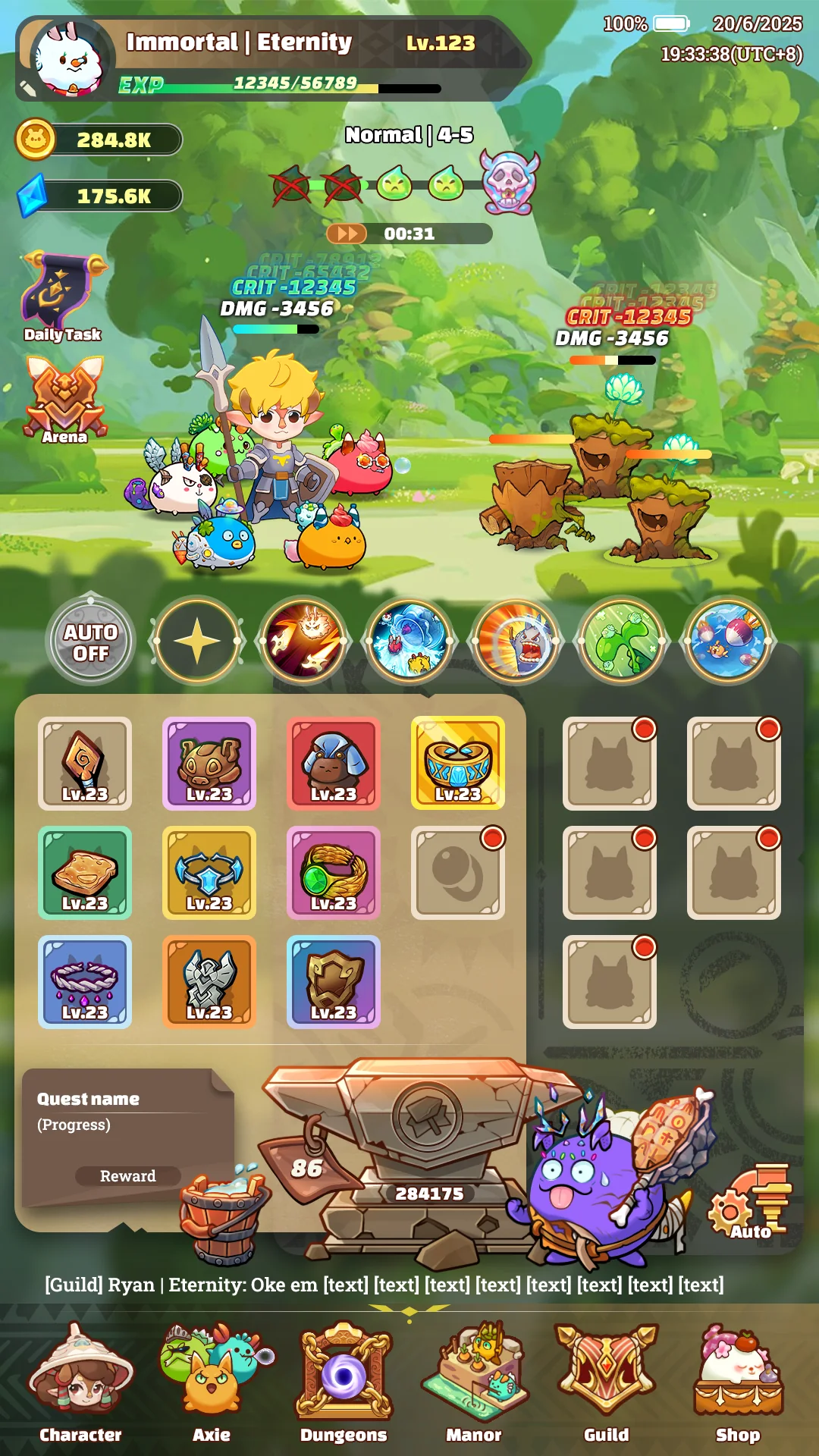
UI and systems in the P2.5 build
Hiring artists
The hardest problem in Project Idle
When I first hired a freelance artist, I made the decision too quickly after an icon test that was not representative enough. The first full screen did not meet the project's quality bar. I explained the issue clearly, ended the engagement, and accepted the lost deposit rather than continuing in the wrong direction.
I then tried to develop someone in-house by inviting a junior with an architecture background to learn game art while working for three months. The next attempt with a fine-arts student showed stronger drawing skills, but the concept work, speed, and collaboration style still did not fit the team.
With each attempt, I made the portfolio review deeper, created tests closer to the actual product, and stated expectations more clearly from the start. The process eventually helped the team find a suitable artist and changed how I recruited specialist roles afterward.
Working model
From a remote team to a small studio in Ho Chi Minh City
P1 was fully remote, but the coordination speed did not fit a product that was changing constantly. In late 2024, I spent approximately one week planning to move the core team to Ho Chi Minh City after Lunar New Year. The initial annual budget of approximately 90,000 USD was reduced to 60,000 USD after the team and mentors raised the risk of scaling too quickly.
The core team included me, a Unity developer, a UX designer, and an intern or junior game designer; we recruited the artist in Ho Chi Minh City. After Lunar New Year 2025, the Unity developer and I moved from Hanoi, set up the studio, and began working on-site. I handled the server and game logic directly while the developer owned the Unity client. This setup helped the small team move quickly, but it also showed me that too much knowledge was concentrated in one person and needed to be documented as the team grew.
3D R&D
A detour that became valuable later
In mid-2025, the team spent three months learning and testing a 3D pipeline, but did not produce output that Project Idle could use immediately. After reviewing the time and capabilities available, I stopped that direction and brought the team back to finish the 2D version.
Although it did not contribute directly to P2, the R&D gave the team experience with models, animation, scenes, materials, and shaders. That experience became useful when the next project moved fully into 3D. The larger lesson was that every major experiment needs a time limit and clear stopping conditions from the beginning.
2D PvE boss demo · Direct combat experiment
P2.5 trailer · Idle RPG build from late 2025
Product decision
Why Project Idle ended at P2.5
While finishing the MVP, I experimented with a PvE boss mode built around a five-character party, inspired by Cult of the Lamb. It sat outside the core idle loop, but attracted more interest when the trailer was released.
Feedback showed that the target audience wanted to participate directly in combat rather than watch characters fight automatically. Although the Idle RPG was relatively complete, we chose not to keep investing simply because the product had already come this far. Project Idle ended at P2.5; its PvE boss concept and 3D experience became the foundation for Lunacia: The Original Dream in early 2026.
Role & responsibilities
- Owned product direction, game design, and the development plan from prototype to trailer.
- Built the original Cocos Creator prototype; after the move to Unity, directly implemented server and game logic.
- Planned the budget and core team, then recruited the developer, designers, and artists directly.
- Set up an on-site studio in Ho Chi Minh City and coordinated work across the server, Unity client, design, and art.
- Led the 3D and PvE boss experiments, then used trailer feedback to stop Project Idle and change direction.
Results
- Received approval for approximately 500-700 USD per month for a developer and a planned art package of approximately 2,500 USD.
- Recruited a Unity developer who continued working with me on later projects.
- Operated P2 on approximately 60,000 USD per year, one third below the initial plan.
- Built an on-site core team and a relatively complete Idle RPG, then released its trailer in late 2025.
- Trailer feedback showed that direct PvE combat was more appealing than the core idle loop, becoming an input for Lunacia.